
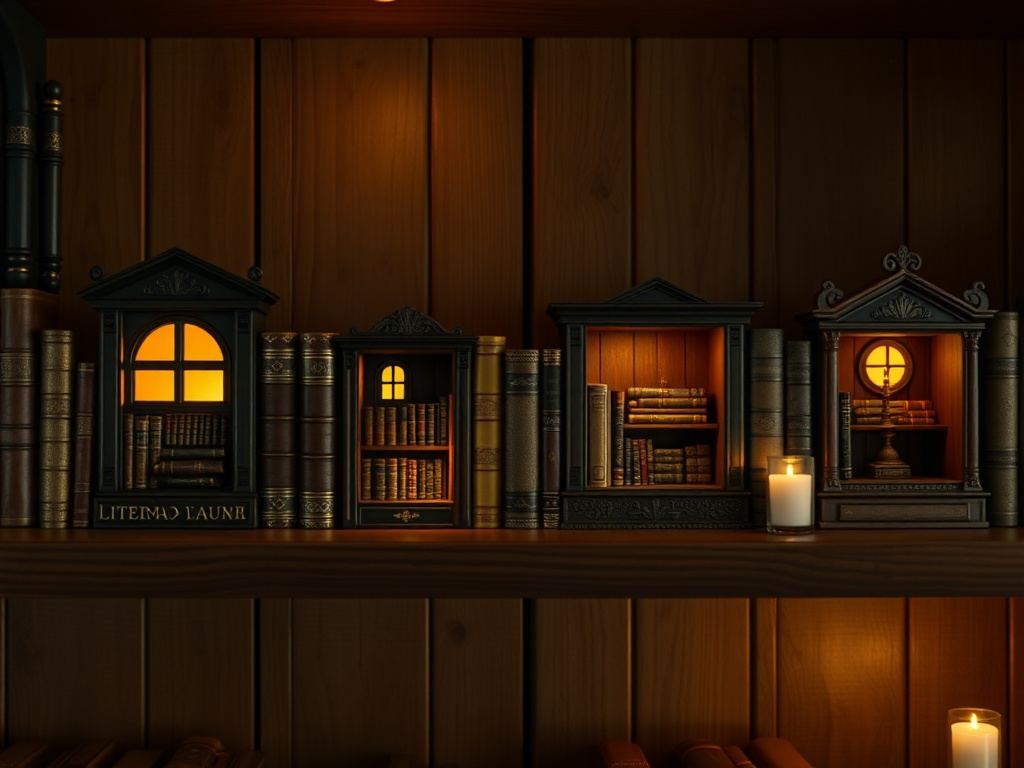
There are more book nook kits on the market than ever — glowing alleys, wizard libraries, sakura streets, tiny cafés — and most of them photograph beautifully. The harder question is which one will actually suit you: your patience, your shelf, your budget, and the person you might be gifting it to. This guide walks through everything we’d tell a friend before their first (or fifth) kit.
What makes a good book nook kit
A book nook is a miniature scene that slots between the books on your shelf, usually lit from inside with a warm LED. The difference between a kit you’ll finish and one that gathers dust comes down to four things:
- Cut quality. Laser-cut wood should click together with light pressure. If parts need forcing or trimming, every step gets slower.
- Instructions. The best manuals number every piece and show each step from two angles. This matters far more than piece count.
- Lighting. Nearly all good kits include a warm white LED — check whether it’s battery (2× AAA is typical) or USB, and whether the switch is reachable once shelved.
- Scale. Most finished nooks stand 20–25 cm tall and 8–12 cm wide — measure your shelf gap before you order, not after.
Match the kit to your experience
First-time builders
Start with something under 250 pieces and a single room. Kits like an owl bookstore or a small café teach you the core skills — folding paper scenery, threading LED wire, gluing without haze — in 2–4 relaxed hours. Our book nook kits collection marks difficulty on every product page.
Intermediate makers
Two-storey scenes, working drawers, more detailed furniture. Expect 6–15 hours. This is the sweet spot of the hobby — enough challenge to stay interesting, never so much that it stalls. Most of our kits for adults live here.
Experienced builders
Large dollhouse-style builds and multi-room scenes with custom wiring. See the dollhouse kits if you want a project measured in weekends, not evenings.
Choosing by theme
Theme is where the heart decides. A few honest notes from the shelf:
- Libraries & bookstores — the classic choice, and the one that looks most at home between real books. Browse library & bookstore kits.
- Japanese streets & sakura — lantern glow and cherry blossom; consistently the most atmospheric builds. See Japanese & sakura kits.
- Fantasy & magic — wizard studies and enchanted forests, from Harry Potter book nooks to castles.
- Steampunk — brass, gears and gaslight; a niche that photographs wonderfully. See steampunk book nooks.
Budget honestly
Around 80% of kits on the wider market sit between $20 and $50; well-made mid-size kits typically run $50–90, and large lit dollhouses $90–130. Cheaper isn’t automatically worse — but under $25, cut quality and instructions are where corners get cut. Our own kits run $55–123 and are sold and shipped by Amazon.
Which brand should you trust?
The big three names you’ll meet are Rolife, Robotime and Cutebee — related in surprising ways (Rolife is Robotime’s flagship line, for a start). We wrote an honest, detailed brand comparison covering cut precision, instructions and value.
Before you click buy — a 60-second checklist
- Does the finished size fit your shelf gap?
- Is the difficulty honest for your experience?
- LED included, and batteries or USB?
- Are the tools in the box (glue, tweezers), or do you need your own? Our tools & techniques guide covers what’s worth having.
- Gifting? Consider a gift-ready set — boxed to be opened in front of someone.
Frequently asked questions
How long does a book nook take to build?
Small kits: 2–4 hours. Mid-size: 6–15 hours. Large dollhouse-style builds: 20+ hours, best spread over a few weekends.
Do I need experience?
No — pick a beginner kit and follow the illustrated steps. The skills build themselves.
Are book nooks good gifts?
They’re one of the most-loved gifts for readers and makers: hours of screen-free making, then a keepsake that stays lit on the shelf. Start with gifts for book lovers.
Built or planning this one? Share it with fellow makers
Join the book nook community
Swap builds, ask for help and show off your lit shelves. These are the friendliest corners of the miniature-making world.